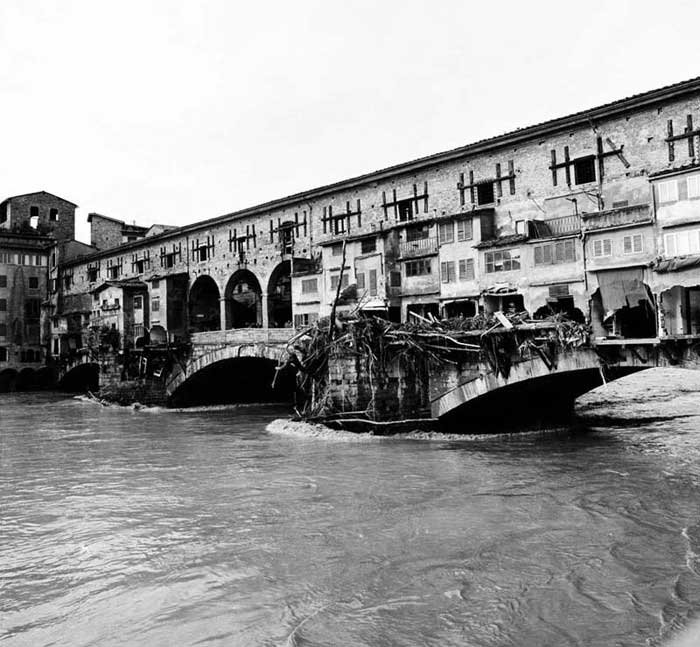
The Flood of 1966: Florence, Italy
(Alluvione di Firenze del 4 Novembre 1966)
Part 3: Summary
“I was already in a kind of ecstasy by the idea of being in Florence, and the proximity of the great men whose tombs I had just seen. Absorbed in contemplating sublime beauty, I saw it close-up – I touched it, so to speak. I had reached that point of emotion where the heavenly sensations of the fine arts meet passionate feeling.”
– Stendhal
The first time I visited Florence, Italy, I may have developed a slight case of Stendhal syndrome. The art, the history, the beauty – all in this one super concentrated area – it was almost completely overwhelming. And I felt that I needed to learn more about it all. So, in the course of a historical deep dive into the city, I learned about the Flood of 1966. I chose the topic for this library guide because of its relation to libraries, art, culture, conservation, and restoration… and because I thought that others might find the overall story interesting as well.
In order to find representative and complementary reference sources on a topic, it is important to carefully evaluate materials for inclusion. According to Cassell & Hiremath (2018), “developing a reference collection must be carefully orchestrated; each step requires great thoughtfulness and care” (p. 347). I took a look at the required resource types for this assignment and considered the scope, quality of content, authority, arrangement of material, and format for the works presented. I hope that the selections can help enlighten those who want to learn more about this historical flood.
—
Bamforth, I. (2010). Stendhal’s syndrome. British Journal of General Practice, 60(581), 945-946.
Cassell, K. A., & Hiremath, U. (2018). Reference and information services: An introduction (Fourth ed.). ALA Neal-Schuman.
Stendhal. (1854). Rome, Naples et Florence. France: M. Lévy Frères.
Stendhal syndrome. (2021, October 1). In Wikipedia.
 db
db 