Jack & Jordie LLP
2021-2022 Library Department Budget
LIS 605 | Summer 2021 | Dr. Suellen Adams
DB | KD | JF
Introduction (DB)
Jack & Jordie LLP is an international law firm headquartered in Hattiesburg, MS, with 8 offices around the globe. The Library Department supports over 300 attorneys and other legal staff worldwide. With 20 information professionals and a presence in all of the firm’s U.S., European, and Asian offices, the Library’s research team fields corporate and legal research queries 24/7/365. On-site libraries are always open for browsing and checking out materials, even when not physically staffed. Online access has been configured and designed to be accessible both inside the office and off-site when logged into the Firm’s network.
The print collection contains nearly 5,000 volumes. While print materials are primarily located in the main library in Hattiesburg, other offices do have satellite collections. Electronic access to various databases, treatises, case law, and other legal materials has been steadily increasing over the years. Over 1,500 electronic titles have been cataloged in the Library OPAC, with other database access points available on the research portal of the Firm’s intranet.
Mission Statement (DB)
To provide the keys to knowledge through collaboration, innovation, and research for the benefit of the Firm and its clients. The library is more than a place – it is a service.
Collection Policy (KD)
The Firm Library will provide collections and access to materials primarily regarding the United States federal law and all fifty states, with a particular collection emphasis on materials for law practices in the state of Mississippi and its border states. In addition, the Library will collect materials for states where the law is either unique, influential, or of great importance to the practices of this office or in current legal events. The Library may also collect foreign, comparative, and international legal materials as needed by professionals. Every year, upcoming cases and legal issues will be taken into consideration when purchasing specific subject areas and legal resources. Collection development will also be influenced by outside professional groups on various web-based journals and sites that discuss and identify major legal issues currently being studied in schools and major legal firms in the state.
The Firm itself is the source of funding for the Library, and all resources will be purchased at its sole discretion. Library materials will be provided to users in a variety of ways, such as print, audio, visual, online databases, and web-based treaties and journals. Any donated materials will be reviewed on a case-by-case basis to evaluate their relevance and value.
Acceptable Use Policy (JF)
Full Library services are available to both current employees and emeritus employees of the Firm. The only acceptable use of the Library is to conduct official Firm business, including client-billable work and prospective business development. Library services are not to be used for matters or inquiries of a personal nature.
Full services include:
On-site access to the Firm Library
On-site access to computers, printing, and scanning
Access to Electronic Resources, both on-site and remote
Interlibrary Loan Services
Borrowing privileges for circulating collections
Reference and Instruction Services
Basic Library services are available to those who are not currently affiliated with the Firm but have a direct interest in the business of the firm, such as clients and paralegals.
Basic Library services include:
On-site access to the Library
On-site use of computers and most electronic resources (some restrictions apply)
Borrowing privileges for circulating collections
Basic reference service
The Firm expects all employees to have mutual respect and consideration for each other and when representing the Firm, such as to clients or vendors. The Library adheres to this same acceptable behavior guideline and expects all patrons and Library staff to be in compliance.
The Firm Library respects each patron’s right to privacy and confidentiality. No information in regard to a patron’s use of Library services and resources will be released outside of the Firm except in the event that a lawfully issued subpoena, search warrant, or other lawful order is served.
If an employee or staff member neglects the policy set forth by the Library, the person in question will then have their access to the Library’s resources restricted.
Funding/Sources of Revenue (DB)
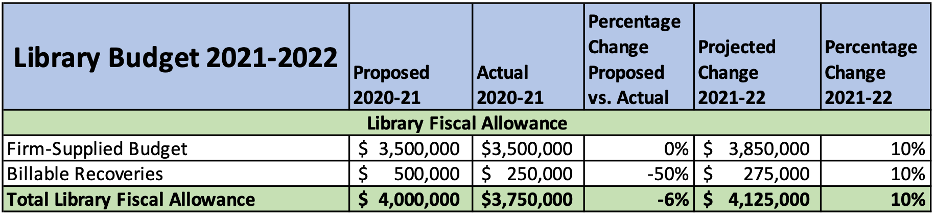
The 2021-2022 budget represents a 10% increase in Firm-supplied funding over 2020-2021. The Firm did well overall in 2020-2021 as it weathered the extraordinary circumstances due to the Covid-19 pandemic. Because of this and the fact that Firm Administration recognizes the Library’s value, the Firm continues to generously support the Library. The 2021-2022 budget also includes a 10% increase in projected billable recoveries over the previous year’s actual rate. While the projected 2021-2022 amount of $275,000 is significantly below the $500,000 proposed in 2020-2021, the Library anticipates a continued decline in department recoveries. The projected amount represents the belief that clients may still be unwilling or unable to pay for researcher-billed time and/or database cost recovery, particularly due the ongoing pandemic. Because of financial stresses for many of its clients in 2020-2021, the Firm has been open to billing arrangements that reduce non-attorney costs; these alternative arrangements will likely continue throughout 2021-2022.
Expenditures (DB)
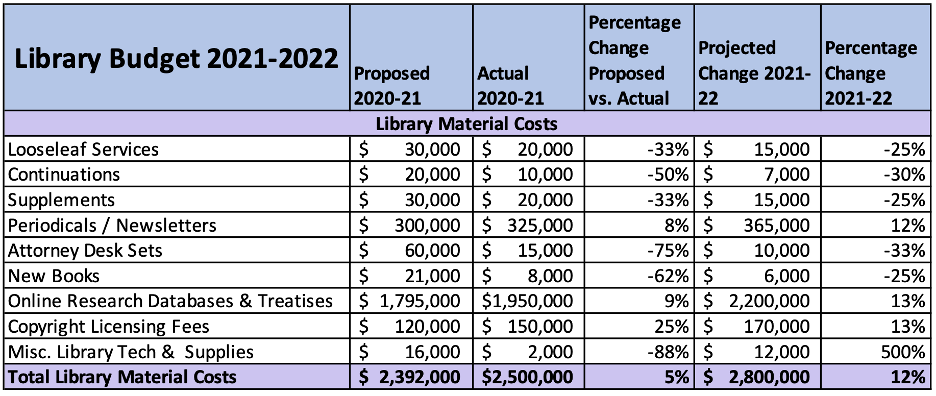
The 2021-2022 Library expenditures budget is a reflection of a changed world and information landscape. Material costs are expected to increase by 12% primarily due to greater spending on electronic resources. Coupled with only a 10% increase in the firm-supplied allowance and a projected 10% increase in billable recoveries over the previous year, the Library recognizes that hard choices must be made. The 2021-2022 budget unfortunately presents a reduction in the Personnel budget to accommodate expenditures elsewhere.
The Covid-19 pandemic brought many changes to how Americans conduct business over the past year. This includes how people work, where they work, and when they work. With employees working remotely, both needs and habits of workers changed, including at Jack & Jordie LLP. And the Library had to maneuver through the many challenges offered by this new work environment – most significantly in terms of online resources.
The Firm went into a closed lockdown in all offices in March 2020 and only started reopening offices in May 2021, and then only at a reduced capacity. Because of this, attorneys and staff had to do all work remotely. This meant that there were no print books, no office desk sets, no routed print periodicals, etc. The Library was tasked with making print resources available through online offerings where possible. If exact complements could not be found, analogs were evaluated and adopted. There is no hard mandate for attorneys and staff to return until after Labor Day 2021, when a hybrid in-office/remote schedule is expected to go into effect.
The proposed 2020-2021 budget must be studied a bit to explain some of the shifts in resources in the 2021-2022 budget. Last year’s budget versus the actual spend was significantly different in most areas as in-person work shifted to remote and print priorities changed. For example, actual spending on Attorney Desk Sets was down 75%, New Book purchasing was reduced by 62%, and Continuations were dropped by 50%. However, while some costs were down (due to reallocating funds), other costs went up significantly over the 2020-2021 projections. Online Research Databases & Treatises went up by $155,000 (9%) and Copyright Licensing Fees went up by $30,000 (25%).
For 2021-2022 budget, the Library forecasts that the trend towards online adoption and push to reduce the amount of print holdings will continue. However, electronic access to materials costs significantly more than the same holdings in print. Additionally, vendors have been ready and willing to increase database fees year over year. The Library projects a 13% increase to the budget for electronic resources. Two other significant increases can be found in copyright access fees and periodicals (some periodicals only offer print/electronic “bundles,” so this reflects the need to increase electronic access to these holdings as well).
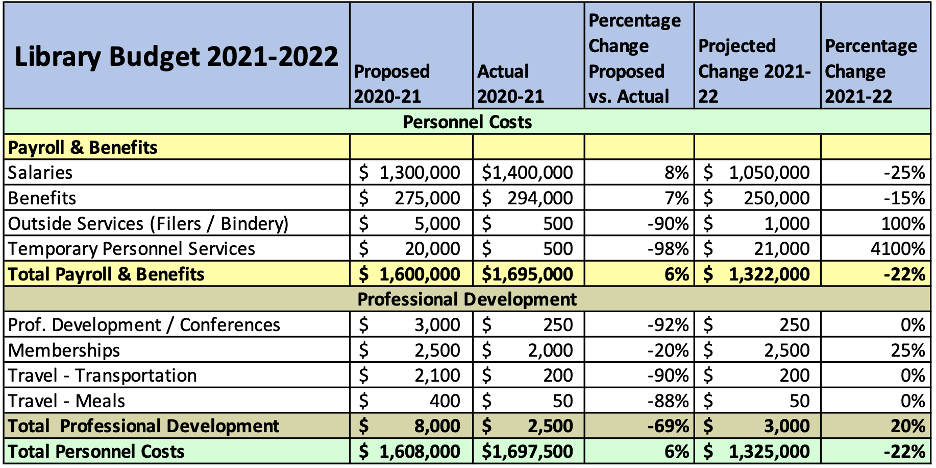
As noted above, the Personnel budget had to be reduced to accommodate the increases in Material costs (specifically electronic resources). Salaries actually increased over projections in 2020-2021 as a new employee was moved to the Library’s roster due to departmental shifting within the Firm. However, in 2021-2022, that employee’s position has been transferred back to the original department. The Library is able to further reduce the salary + benefits budget for 2021-2022 by 25% due to staff attrition in three positions that were classified as redundant or no longer sustainable. There will be a small professional development increase for 2021-2022, but still 63% less than was budgeted the previous year.
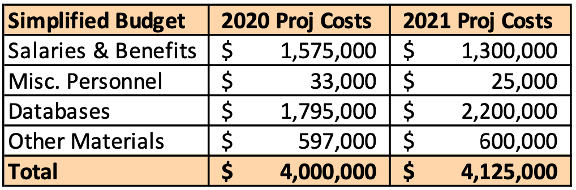
The Simplified Budget below may help illustrate that the majority of the budget is spent on salary + benefits and electronic resources. However, note the changes in projected costs between the two years – down for Salaries and up for Databases.
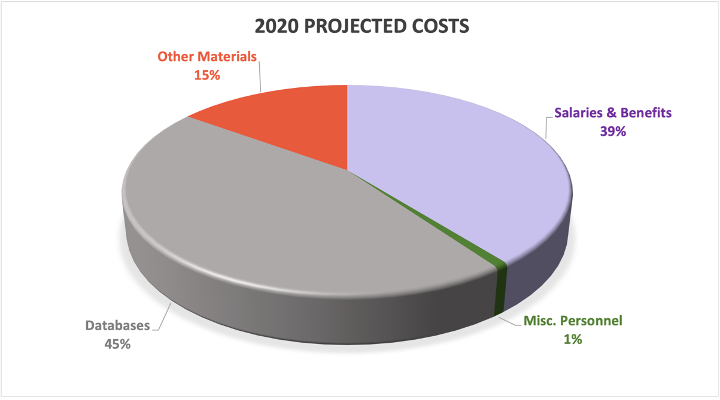
In the 2020-2021 Budget projection, Salary & Benefits comprised 39% of the Firm-supplied budget, whereas databases made up 45%.
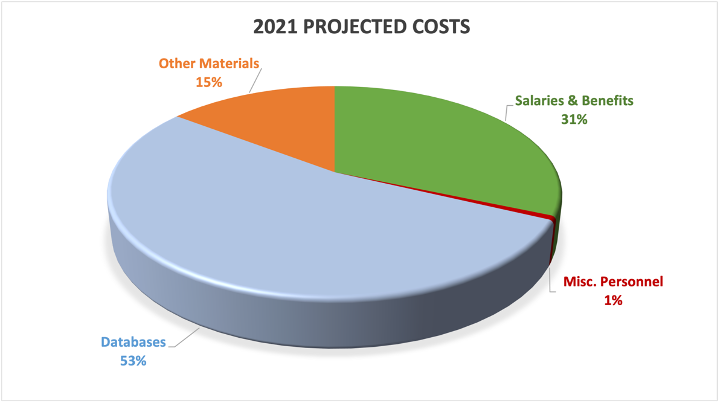
For 2021-2022, the Library is projecting that Databases will comprise more than half of the budget (53%), up 8% over the 2020 projected costs. Salaries & Benefits are undeniably affected, showing an 8% decrease.
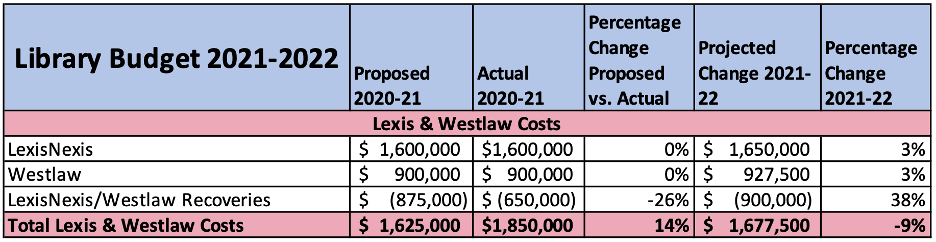
And finally, the LexisNexis and Westlaw budget is shown below. Although these costs are paid directly by the Firm and not out of the Library’s budget, it is important to include them in the 2021-2022 Library Budget document. The Library is de facto in charge of these resources as it is responsible for maintaining the vendor relationships, negotiating the contracts, conducting training at the Firm, internal database technical support, etc. These costs are fixed 3-year contracts with the respective vendors, and both will increase 3% over the previous year. The main difference to note is the recovery rates. There was a projected recovery of 35% in 2020-2021. Real recovery was only 74% of that, for a total of $650,000. The significant reduction in actual recoveries is also mentioned in the Funding section, e.g., alternative billing arrangements for clients. However, the Library projects a 35% recovery rate for LexisNexis and Westlaw in 2021-2022.
Budget Summary Narrative (KD & JF)
This budget reflects the mission and values of the law library at Jack and Jordie LLP. During these uncertain times we have used our best judgement and resources to try to accurately allocate funds to the most relevant resources, materials, and media that will be used in the coming year. Our budget has been heavily influenced by the pandemic and the shifts in business that we have had to adopt. Due to the decrease in revenue, our budget reflects cuts in departments that were either reduced or not applicable due to the restrictions in place because of the pandemic. The general objectives for this budget are to uphold the services provided by the library to the clients and to not sacrifice quality in results. The law firm of Jack and Jordie LLP will strive to pay for all current operating expenditures with the current revenues. This budget includes and braces for the 12% decrease in revenue for this upcoming year.
A. Salaries – $1,400,000
The Library is able to reduce the salary + benefits budget for 2021-2022 by 25% due to staff attrition in three positions that were classified as redundant or no longer sustainable. The Library also reduced salaries by having one employee transfer back to another department. These adjustments to staff will not impact the services available or the completeness of services rendered. These staffing adjustments were decided with support from ongoing observations from the previous year.
B. Benefits – $294,000
The Library is able to further reduce the benefits budget for 2021-2022 by 25% due to staff attrition in three positions that were classified as redundant or no longer sustainable. The Library also reduced benefits by having one employee transfer back to another department.
C. Temporary Personnel Services – $500
The Library was fortunate to have limited turn over and limited long term absences. The Covid 19 pandemic allowed us to retain quality personnel and decrease the amount expended on temporary personnel services. Temporary personnel are mostly comprised of filers.
D. Outside Services – $500
The budget decrease in this category resulted from switching to services primarily in house. The pandemic also affected this area when business closures caused limited outside resources. Further, to keep the safety of employees a priority, outside resources that could be transferred to in-house in order to reduce the amount of face-to-face contact were switched.
E. Professional Development and Travel – $250/each
The decrease in this category was due to the Covid 19 pandemic and the travel restrictions that followed. Most of the professional development that was completed was done virtually at a lower cost to the Library. The pandemic also limited the number of opportunities to travel to and attend conferences as many were cancelled or moved to an online platform. Within the next five years, this is expected to change, and normal travel and professional development opportunities should resume.
F. Looseleaf Services – $20,000
The Library is transitioning more to database research in and outside of the office causing a decreasing demand in print services and a decrease in the looseleaf services budget. Many of the previous print publications are now digital and kept up to date with no lay time. Many of the publications are also available within one database which further decrease the budget for looseleaf and print services.
G. Continuations – $10,000 and Supplements – $20,000
Continuations and supplements are used in the law library to periodically update publications and other resources. Continuations can be published quarterly or biannually. These are published indefinitely or until the resource ceases to be published. These are rotated out and archived once they are older than five years. The decrease in the budget for these materials is due to the accessibility that is now available in online journals and databases for these publications. This move to digital continuations are also helpful in clearing shelf space for other resources to be better utilized.
H. Periodicals – $325,000
The most up-to-date service next to database research are periodicals. This increases demand for the frequent publication of these materials leading to an increase in the budget.
I. Attorney Desk Sets – $15,000
The reduction of new hires and continued demand for database research reduced the demand for hardback publications and a decrease in the budget for attorney desk top sets. While these desktop sets are still relevant, they are slowly being replaced with other media that contains the same information at a fraction of the cost.
J. New Books – $8000
The continued increase in demand for database research decreased the number of new books purchased and a decrease in the budget for new books. In addition, book access was restricted to prevent the spread of the virus which cut down on the normal wear and tear that happens over the course of the year.
K. Online Research Databases and Treatises – $1,950,000
The rise of interest in doing research online from the desk or home increased the demand for database research. The databases are much more practical in that they contain past volumes, publications, and research up to the present day. The database costs for subscribing and purchasing access also rose which in turn required an increase in the amount of the database budget.
L. Copyright Licensing Fees – $150,000
This category increased because periodicals have increased. We also pride ourselves on sharing information within and outside of the firm. Because of this commitment we have to our clients, copyright fees are increasing along with the budget for copyright licensing.
M. Miscellaneous Library Tech and Supplies – $2000
This category decreased as a result of the pandemic with more employees working from home and the need for supplies decreasing. All employees were given their own set of necessary tech and tools to use at home. Replacements and updates were issued as needed. Overall, the amount of supplies decreased due to most tasks being completed online and through other digital means.
Total: $2,500,000
View original pdf: Budget
 db
db 